Categories
News

Cornell First Amendment Clinic Sues USCIS and ICE on Behalf of Nonprofit Newsroom Documented

The Cornell Law School First Amendment Clinic filed suit September 29 on behalf of Documented, a New York nonprofit news outlet, and journalists Lam Thuy Vo and Max Siegelbaum, seeking immigration records from U.S. Citizenship and Immigration Services and U.S. Immigration and Customs Enforcement that could inform the public about rapid and ongoing changes to the asylum process and alleged misconduct by Department of Homeland Security agents. Documented’s community-driven reporting has deepened public understanding of the issues immigrants face and shaped immigration policy — work that depends on access to the very government records the agencies are now withholding.

The complaint, filed in the Southern District of New York, seeks access to an updated copy of a USCIS dataset on asylum applications, as well as closing memos on certain investigations into alleged misconduct by DHS agents.

In October 2025, Vo submitted a Freedom of Information Act request to USCIS asking for an updated copy of a database that had previously been produced after Vo filed a FOIA suit to obtain the records. Despite the urgency of the public need for the information, Vo’s request has remained #187 in a growing request queue since February 5, 2026. 

In November 2025, Siegelbaum submitted a FOIA request to ICE seeking “all closing memos and other memos and attachments related to investigations led out of the Office of Professional Responsibility, into allegations of misconduct of DHS agents, including ERO and HSI and any other individuals covered by the office’s purview,” limited to documents generated from January 1, 2024, until the date the request is fulfilled. ICE closed the request without notice and on grounds that have no basis in FOIA, claiming that plaintiffs “refus[ed] to specify the scope” of the FOIA request. In fact, ICE effectively asked the plaintiffs to provide the very information Siegelbaum sought – the specific investigations, incidents, locations, names and titles of officials.

“This case is about the public’s right to understand what its government is doing — from how it treats people seeking asylum to how it polices misconduct within its own ranks,” said Michael Linhorst, Clinic Local Journalism Attorney. “When agencies stall lawful requests and manufacture obstacles that appear nowhere in the statute, they aren’t just stonewalling journalists. They’re keeping the public in the dark about decisions that affect real people’s lives.”

Documented, Vo and Siegelbaum are asking the court to order immediate production of all records, as well as costs and fees.

Clinic alumnus Alexander Venditti, an attorney at Jones Day, is co-counsel on the case.
Categories
News

Legal Aid, Cornell Law School First Amendment Clinic File Lawsuit to End DOCCS’s Practice of Monitoring Calls Made by Incarcerated New Yorkers to Legal Aid-Operated Helplines

(NEW YORK, NY) — The Legal Aid Society, represented by the Cornell Law School First Amendment Clinic, announced the filing of a lawsuit seeking to end the New York State Department of Corrections and
Community Supervision’s (DOCCS) unlawful practice of monitoring calls made by people incarcerated in New York prisons to Legal Aid-operated helplines.

The complaint alleges that, by subjecting the helpline calls to surveillance, DOCCS is effectively preventing timely, candid communications between incarcerated people and their attorneys in violation of Legal Aid’s First
Amendment rights.

Legal Aid currently operates two telephone helplines that provide free legal assistance to thousands of incarcerated individuals each year. Through the helplines, current and prospective Legal Aid clients may call to speak with legal staff to obtain legal advice, referrals, advocacy, and representation at no cost. The helplines offer incarcerated people assistance with issues such as reports of sexual assault, abuse or brutality by prison staff, and serious medical needs requiring prompt intervention.

Notably, the helplines serve as the only practical means through which Legal Aid can provide immediate assistance to incarcerated people with urgent and time-sensitive concerns, as scheduling a legal call or in-person
visit can take weeks or months.

DOCCS’s surveillance of the helplines, therefore, poses serious safety concerns, as individuals may not feel comfortable disclosing sensitive information related to their safety or the safety of others on a monitored phone line, even if the situation requires prompt attention. Those with complaints about DOCCS staff, moreover, may also refrain from voicing valid concerns over the helpline due to fears of retaliation.

The lawsuit, filed in the U.S. District Court for the Southern District of New York, argues that DOCCS’s surveillance of the sole means of real-time communication between Legal Aid staff and their clients impairs Legal Aid’s ability to deliver the effective legal advocacy that incarcerated New Yorkers are entitled to and seeks to permanently end the monitoring and recording of calls made to the helplines.

“In order for The Legal Aid Society to deliver effective legal assistance to incarcerated New Yorkers, our attorneys must be allowed to communicate with clients in a timely, confidential manner,” said Mary Lynne
Werlwas, Director of the Prisoners’ Rights Project at The Legal Aid Society. “DOCCS’s practice of surveilling these helpline calls does nothing to enhance prison safety. Instead, it takes away the only immediate,
direct line of assistance that incarcerated people are offered and hinders our attorneys’ and paralegals’ ability to provide incarcerated people with confidential legal advice.”

“DOCCS is doing something the First Amendment plainly forbids: surveilling the way a legal organization speaks with the people it serves,” said Daniela del Rosario Wertheimer, Stanton Fellow with the Cornell Law School First Amendment Clinic. “The predictable result is silence — callers who fear retaliation say nothing, or don’t call at all, and those with the most urgent needs go unheard. We are asking the court to end this government surveillance.”

Read more about the case below:

NY prisons can monitor calls to Legal Aid hotlines, lawsuit says, Albany Times Union, Sept. 23, 2026

Categories
News

NYPD Refuses to Release Parking Placard Records

Represented by the Cornell Law School First Amendment Clinic, Streetsblog NYC is appealing the NYPD’s refusal to provide records concerning its roughly 35,000 placards after a FOIL request for all active NYPD parking permits.

Read about the FOIL here: NYPD Refuses to Release Parking Placard Records – Streetsblog New York City, Streetsblog

Categories
News

Cornell Law School First Amendment Clinic Kicks Off Fall Semester with Bootcamp

The Cornell Law School First Amendment Clinic hosted the latest version of its heralded two-day pre-semester Bootcamp on August 21 and 22. Once again the line-up of speakers and panelists was comprised of major figures from the First Amendment and media fields.

This semester’s event opened with a live screening of the latest Clinic-focused eCornell Keynote, Empowering Local News: A Coalition To Strengthen Independent Journalism which featured Heather Murray, Clinic Associate Director and Managing Attorney of its Local Journalism Project; Adam Tragone, the Clinic’s Local Journalism Attorney; Halle Stockton, Editor-in-Chief and Co-Executive Director of Pittsburgh’s Public Source; and Paula Knudsen Burke, Senior Supervising Attorney at the Reporters Committee for Freedom of the Press. The panelists described the unique collaboration between the Clinic, the Reporters Committee and Public Source intended to empower local news in Western Pennsylvania.

Bob Corn-Revere, Chief Counsel of FIRE, delivered the keynote address, offering a unique perspective on First Amendment history through the lens of the obscenity conviction of comedian Lenny Bruce and Corn-Revere’s work to secure a posthumous pardon for the comedian. Corn-Revere told students that “we never seem to run out of First Amendment problems. It really is something you can earn a living at.” He encouraged students to take full advantage of the “valuable opportunity” the Clinic affords.

Bob Corn-Revere, FIRE Chief Counsel, discusses Lenny Bruce

Professor Nelson Tebbe, Associate Dean for Academic Affairs & Jane M.G. Foster Professor of Law, made a welcome return to the Bootcamp, providing students with a grounding in First Amendment doctrine. Michael Grygiel, Cornell Law School Adjunct Professor and partner at Foley Hoag; Kelly McNamee, partner at Foley Hoag; Bob Corn-Revere, Chief Counsel of FIRE; and Lisa Macpherson, Policy Director, Public Knowledge, engaged in a timely discussion of the unique challenges presented by President Trump to First Amendment freedoms, with a special focus on a lawsuit he brought against the Des Moines Register and pollster Ann Selzer over an Iowa poll conducted during the 2024 election.

Clinic students engage with Bootcamp panelists

Molly Linhorst, a Staff Attorney at the American Civil Liberties Union of New Jersey, discussed the ACLU’s ongoing and hard-fought work on behalf of Mahmoud Khalil, the legal permanent resident and former Columbia University graduate student who is fighting deportation arising out of his advocacy related to the war in Gaza.

As part of the proceedings, Alyse Horan ’23 was presented with the Jackson Distinguished Alumni Award for her ongoing work – first as a clinic student and then as an alumni – on behalf of a Texas freelance journalist reporting on deaths along the U.S. and Mexico border. The award is named after the Clinic’s founder and director, Mark H. Jackson, A.B. ’81, J.D. ’85.

Alyse Horan ’23, Jackson Distinguished Alumni Award recipient

Returning students shared advice on making the most of the Clinic experience. Kat Namon ‘27 told attendees that the chance to meet clients and develop litigation skills has been incredible. “Learning how to be professional and how to have those skills in a real live experience is really special,” she said.

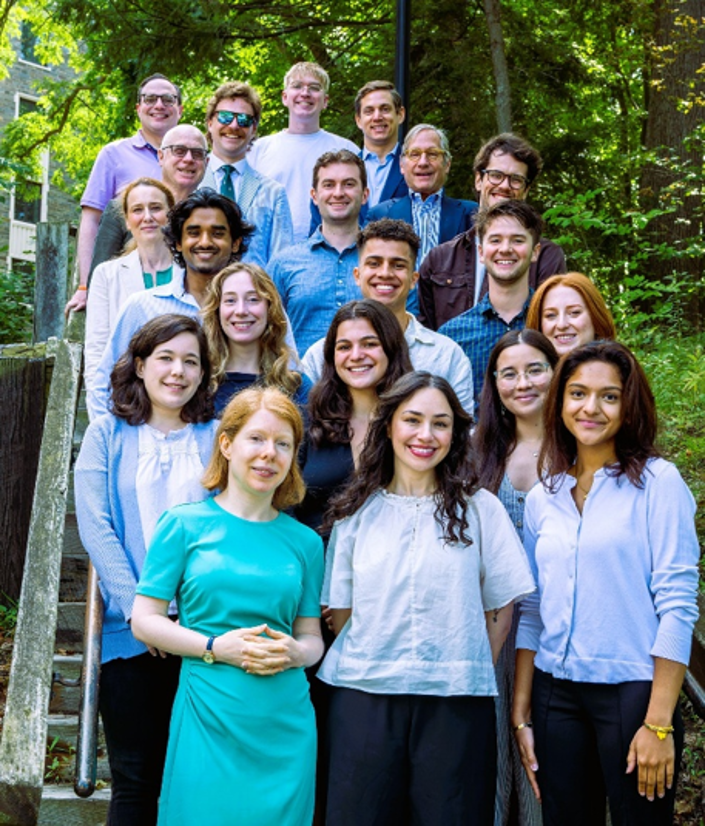
Faculty and Students Attend Clinic Bootcamp, August 2026