The Clinic’s new First Amendment lawsuit, seeking to establish important legal rights for protestors in New York City’s many “privately owned public spaces,” or POPS, attracted widespread attention. Here is a selection of some of the news coverage:
Retired prosecutor David O’Keefe filed a lawsuit today to vindicate his — and the public’s — First Amendment rights after he was arrested while protesting outside the Midtown headquarters of a law firm that made a deal with the Trump administration
The lawsuit, filed in the Southern District of New York, names the City of New York, Brookfield Properties, and others as defendants. It seeks to establish important legal rights for New Yorkers in the city’s many “privately owned public spaces,” or POPS.
O’Keefe was standing in a Brookfield-owned POPS when he was arrested on April 2, 2025. He was protesting outside the headquarters of Skadden, Arps, Slate, Meagher & Flom LLP. Days earlier, Skadden had reached a deal with the Trump administration in which the firm promised free legal services in support of initiatives backed by the President. O’Keefe, as a career prosecutor who views the independence of lawyers and the maintenance of the rule of law as critically important, opposed Skadden’s deal.
Skadden is headquartered in One Manhattan West, an office building owned by Brookfield that sits across Ninth Avenue from Moynihan Station. It is bordered by a POPS.
During his protest, O’Keefe stood in the POPS and held a sign that said, “Hey Skadden, I found your spine in the trash lying next to your values!” It described Skadden as “Trump’s $100 million lap dog.” And to put a finer point on his message, he also held a replica human spine.
This POPS is one of dozens of others in the city. Collectively, they constitute more than 3.8 million square feet of public space, the equivalent of nine Bryant Parks.
POPS are created pursuant to an agreement between the property owner and the city. If the owner agrees to include a POPS on its property, the City will allow the owner to construct a larger building than the New York City Zoning Resolution would otherwise permit.
These POPS are open to the public and indistinguishable from public sidewalks, plazas, or parks. They are spaces where commuters walk to work, tourists gather, shoppers stroll — and where people sometimes hold protests.
But New Yorkers may be surprised to learn that, according to the property owners and NYPD, they do not have First Amendment rights when they are in these vast public spaces. Even though O’Keefe’s protest did not impede the flow of pedestrian travel, did not include sound amplification, and did not violate any rules of the POPS, a security guard working for the property owner told O’Keefe to leave the POPS. O’Keefe refused, prompting security to call NYPD. Officers arrived and told O’Keefe he could not continue his protest in the POPS. When O’Keefe declined to leave or stop his protest, the NYPD officers arrested him.
O’Keefe’s lawsuit seeks to make clear that the public enjoys the same First Amendment rights in POPS as in any other public space. O’Keefe is represented by Michael Linhorst and Daniela del Rosario Wertheimer of the Cornell Law School First Amendment Clinic and civil rights lawyer Gideon Oliver, who has represented people arrested at POPS since Occupy Wall Street.
O’Keefe has continued to protest in the same POPS since his April arrest. He has repeatedly been instructed by security guards to leave and has each time refused. The threat of wrongful government censorship and re-arrest looms every time he ventures out to protest.
“POPS are public spaces. Peaceful protestors should not be silenced just because they choose to protest in one,” O’Keefe said. “This action attempts to hold a major New York City real estate company, Brookfield, to account for its failure to honor the deal and keep public spaces public,” Wertheimer said. “Though building tenants may not like what Mr. O’Keefe has to say, when he says it in a POPS, he is protected by the U.S. and New York State Constitutions. No property owner, security company, or police officer has the power to shut Mr. O’Keefe down for his lawful and peaceful protests.”
The case is O’Keefe v. City of New York et al., no. 1:25-cv-10532.
The First Amendment Clinic won an important appeal on November 26 that strengthens New York journalists’ ability to protect their anonymous sources and the rest of their newsgathering. The appeals court unanimously held that a subpoena of Joseph Abraham, the former managing editor of the Sullivan County Democrat, had to be quashed because the party that issued the subpoena failed to meet the strict test imposed by the New York Shield Law.
The Shield Law protects journalists against being forced to disclose any unpublished information, including information about an unnamed source, even if the source was not expressly promised confidentiality. The law sets out a stringent test a party must meet before it can enforce a subpoena against the journalist. The test requires the party to show that the information is “highly relevant” to the party’s legal claim, “critical or necessary” to the claim, and not available from any other source. Here, the appeals court held that the party failed to meet that test.
In its ruling last week, the Third Department Appellate Division quoted New York’s highest court to emphasize that the Shield Law “codifies this state’s ‘consistent tradition of providing the broadest possible protection to the sensitive role of gathering and disseminating news of public events.’”
“We are heartened that the Appellate Division reversed the lower court and reaffirmed the strength of the Shield Law,” said Michael Linhorst, the clinic’s local journalism attorney.
Michael Linhorst
“The Shield Law provides critical protection for the free press,” Linhorst said. “Without it, journalists would risk being forced to testify whenever they covered a controversial issue —they would become unpaid investigators for the litigants, taken away from their work of reporting for the public.”
The case is Anthony v. Haas et al., a defamation lawsuit in which neither Abraham nor the Sullivan County Democrat are defendants. The suit relates to an investigation the Town of Highland conducted into Marc Anthony, who was then the town constabulary. The newspaper obtained a copy of the town’s investigation report that had not yet been made public, and it published an article about the investigation that referenced an unnamed source. Anthony later sued a town board member, alleging defamation related to the investigation, and he attempted to subpoena Abraham for documents and testimony about the identity of the newspaper’s source, apparently hoping to show that the defendant provided information to the newspaper.
On behalf of Abraham and the Sullivan County Democrat, the clinic asked the Sullivan County Supreme Court to quash the subpoena. The clinic initially succeeded in quashing it on procedural grounds. Later, the plaintiff re-issued the subpoena, and the Supreme Court denied the clinic’s second motion to quash, concluding that the plaintiff had overcome the Shield Law’s test for overcoming the qualified privilege. As the appeals court recognized, this conclusion was incorrect.
The Appellate Division held that because the plaintiff could obtain the information he wanted from the source who spoke to the newspaper rather than the newspaper itself, “Plaintiff cannot show that the information is unavailable from another source,” and so failed to meet the Shield Law’s three-part test. It also faulted the lower court for failing to make the findings of fact on the record in support of its decision that are required by the Shield Law.
In January, the department denied a public records request from New York Focus requesting call logs for the phone number that the agency advertises to people who need help filing claims.
On July 7, after the agency denied an appeal, New York Focus brought an Article 78 lawsuit against the agency, arguing that the records must be disclosed under the law. The case is pending.
“This lawsuit is about making sure New Yorkers can keep tabs on what the Department of Labor is doing and whether it is serving the public as it should,” said Michael Linhorst, the attorney at Cornell Law School’s First Amendment Clinic who filed the suit. “The department appears to be trying to misapply an unrelated confidentiality law to keep the records hidden.”
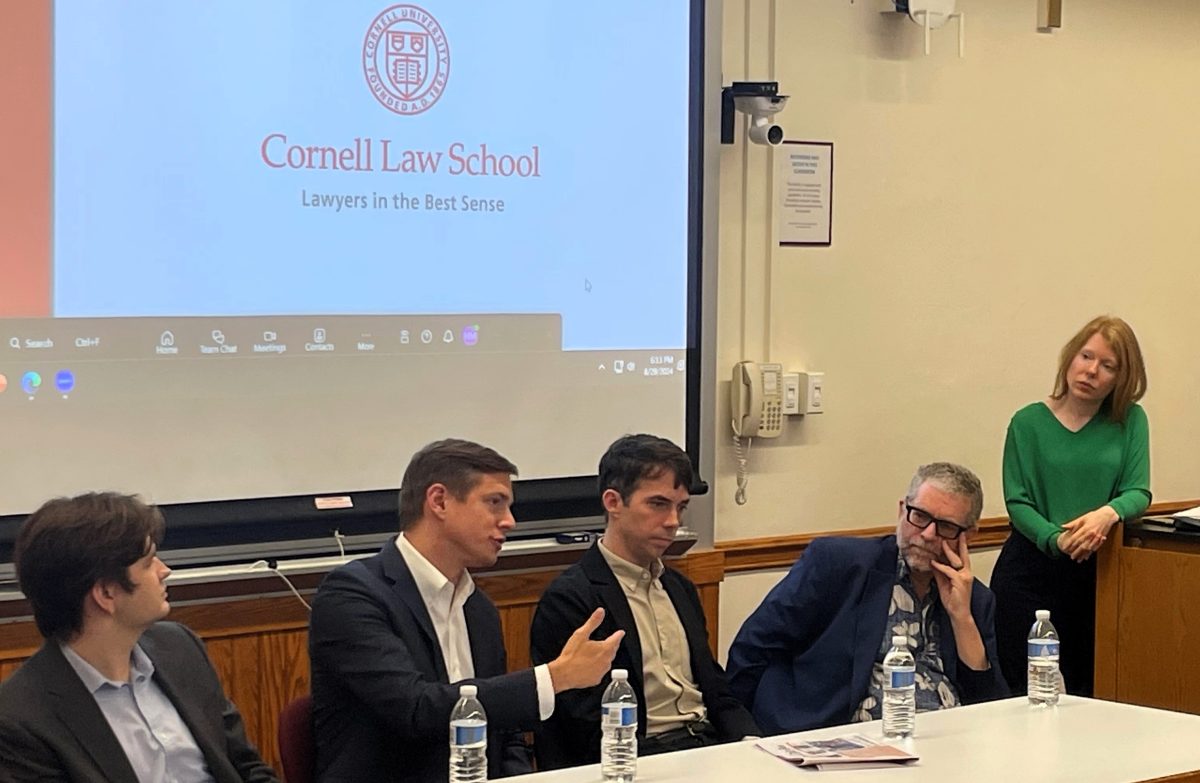
Representatives of Streetsblog NYC and the First Amendment Clinic speak at a recent training session for Clinic students. From left, the panelists were Evan Deakin ’25, a student with the Clinic; Michael Linhorst, the Clinic’s Local Journalism Attorney; Jesse Coburn, Streetsblog’s investigative reporter; Gersh Kuntzman, editor of Streetsblog; and Heather Murray, Managing Attorney of the Local Journalism Project.
NEW YORK, N.Y. – Streetsblog NYC, represented by the Cornell Law School First Amendment Clinic, filed a groundbreaking lawsuit last week against the New York City Department of Transportation, alleging that DOT systematically violates the state’s Freedom of Information Law by forcing nearly everyone who seeks public records to wait six months before receiving any responsive documents.
The lawsuit asks the New York Supreme Court to issue an injunction directing DOT to end its practice of imposing uniform, half-year-long delays that prevent the public from finding out, in a timely way, what its government is up to.
The suit seeks to enforce the basic purpose behind FOIL — to promote an open and democratic government by giving everyone the right to request documents from state agencies. As long as requested documents do not fall into one of the law’s narrow exemptions, the agency is required to provide them — and it must do so in a timeframe that is reasonable under the circumstances of the individual request, typically within 20 days.
The lawsuit alleges that Streetsblog has filed dozens of FOIL requests with the department since 2021, and each one of them has faced a nearly identical, six-month delay. According to the complaint, Streetsblog requested a copy of the DOT Commissioner’s official calendar from a single day. DOT said it would take 187 days to respond. The complaint further alleges that Streetsblog requested DOT’s phone or email directory, and the agency again said it would take 187 days — and then it ended up missing its own deadline. In another instance, according to the complaint, Streetsblog asked for a copy of a single contract, which it identified by contract number. DOT said its response would take 182 days.
“By imposing a six-month blanket delay in response to every one of our client’s requests, DOT is obviously making no effort to determine what a reasonable response time would be for each request,” said Michael Linhorst, the Clinic’s Local Journalism Attorney. “They are regularly flouting the clear requirements of the law.”
Relying on public data, the complaint alleges that Streetsblog is not alone. According to the complaint, out of all the requests that DOT received between June 2021 and August 2024, the department gave itself an average of 182 days to respond. Almost every single request — more than 98 percent of them — was delayed by longer than 170 days.
“This case is important not just to Streetsblog but to scores of reporters around the city whose ability to inform the public depends on receiving timely information from government officials,” said Gersh Kuntzman, editor of Streetsblog. “By routinely delaying virtually every Freedom of Information Law request, the Adams administration effectively delays coverage of its actions so long that it becomes less newsworthy compared to whatever story of the day reporters are chasing.”
By filing this lawsuit, the Clinic is seeking to establish new legal precedent. While such “policy or practice” cases are widely accepted in federal litigation regarding the Freedom of Information Act (FOIA), New York courts have not yet recognized the claim under FOIL.
“Policy or practice claims give federal FOIA teeth,” said Evan Deakin ’25, a Clinic student who worked on the complaint. “If these claims are recognized under New York FOIL, agencies will no longer be able to use delay to circumvent the law’s requirement that government records be available to the public.”
The lawsuit, Kuntzman et al. v. New York City Department of Transportation, is now pending in the New York County Supreme Court.
In addition to Linhorst and Deakin, Clinic students Andrew Brockmeyer, Sophia Gilbert and Cameron Misner and alumna Fernanda Pires Merouco worked on the lawsuit and the legal arguments behind it, with supervision from Heather Murray, Managing Attorney of the Clinic’s Local Journalism Project.
Contact:
Michael Linhorst, Local Journalism Attorney at the Cornell Law School First Amendment Clinic, at MML89@cornell.edu