The Clinic filed a lawsuit in the U.S. District Court for the Northern District of New York in December 2023 against Delaware County on behalf of Catskills-based newspaper The Reporter. The suit claims that county officials violated the paper’s constitutional rights in de-designating it as an official paper and in issuing what has amounted to an illegal gag order for county employees. Read The Times Union coverage of the suit here and Cornell Law School’s coverage of the suit here.
NEWFANE, NY – On June 21, 2023, Cornell Law School’s First Amendment Clinic filed a lawsuit in Niagara County Supreme Court on behalf of Tracy Murphy, animal rights activist and founder of Asha’s Farm Sanctuary in Newfane New York. The suit, an Article 78 petition, challenges a gag order Newfane Town Court Justice Bruce Barnes imposed on Murphy restricting her First Amendment rights while she awaits trial on a misdemeanor larceny charge stemming from a dispute over the ownership of two cows.
The gag order imposes a blanket ban on Murphy’s use of any form of social media – which the order defines to “specifically include Facebook and public billboards, etc.” – while the criminal case against her is pending. Murphy’s suit challenges the gag order on several grounds, including that the gag order is an unconstitutional prior restraint of speech in violation of the First Amendment, that the order is unconstitutionally vague and overbroad, and that the order violates New York bail laws.
“The ability to interact with others on social media – whether that be through ‘liking’ posts, commenting, or perusing timelines – is critical to the exercise of First Amendment rights in the modern day,” said First Amendment Clinic Summer Fellow Eman Naga. “By blocking Murphy’s ability to use social media and express her views publicly, the gag order effectively strips Murphy of her voice. It also sets a dangerous precedent for other criminal defendants to be unlawfully silenced, too – regardless of whether they share Ms. Murphy’s views about animal rights.”
“Asha’s Farm Sanctuary is founded on spreading hope and love,” stated Murphy. “The gag order is inhibiting my ability to do just that, as well as my ability to fundraise for the Sanctuary and advocate for myself and the animals I care so deeply about helping.”
“The Supreme Court has made very clear that blanket gag orders like the one Ms. Murphy challenges are unacceptable under the First Amendment,” said Christina Neitzey, Stanton Fellow at the First Amendment Clinic and counsel for Murphy. “Courts cannot pick and choose who gets to enjoy free speech rights based on factors like politics and personal lifestyle differences. For the First Amendment to mean anything, we must all have these rights—vegans and ranchers alike.”
Murphy is represented in this suit by Neitzey, assisted by Clinic Summer Fellows Naga and Karem Lizbeth Herrera. The matter is pending in Niagara County Supreme Court as Murphy v. Barnes, Index No. E180218/2023.
Murphy is represented in the parallel criminal matter by Chris Carraway with the Animal Activist Legal Defense Project at the University of Denver Sturm College of Law, Wayne Hsiung of Direct Action Everywhere, and Bonnie Klapper, former federal prosecutor and current member of the Direct Action Everywhere Legal Team. Murphy’s criminal defense team previously challenged the same gag order before Justice Barnes, as well as an earlier version of the gag order Town of Somerset Justice Pamela Rider imposed at Murphy’s arraignment.
* * *
Contact: Christina Neitzey, cn266@cornell.edu, 607-255-4196
Last month, Cornell Law School’s First Amendment Clinic and co-counsel Greenberg Traurig LLP finalized a settlement agreement which allows citizen journalist James Meaney of Geneva, New York, to stand by his investigative reporting on local construction company Massa Construction, Inc. This agreement resolves a lawsuit Massa brought against Meaney and his watchdog blog The Geneva Believer nearly three years ago.
The suit centered around a series of articles in which Meaney examined — and at times criticized — the City of Geneva’s public works bidding and record keeping procedures generally, and the relationship between Massa and the City specifically.
Massa appealed two 2021 Ontario County Supreme Court decisions which dismissed Massa’s suit and awarded attorneys’ fees to Meaney’s legal team to the New York State Appellate Division, Fourth Department. The matter settled after briefing was complete on the appeals, but prior to oral argument before the Fourth Department.
Neither Meaney nor The Geneva Believer made any payment to Massa as part of the settlement. Meaney and his legal team maintain that —as Supreme Court, Ontario County, found — Meaney’s coverage of Massa contained no false statements of fact, alleged or implied. Remaining details of the agreement are confidential.
“Citizen journalists like Jim Meaney are exactly who anti-SLAPP laws are intended to protect,” said Christina Neitzey, Stanton Fellow in the Cornell First Amendment Clinic. “We are relieved that, through this settlement agreement, Jim can stand by his reporting and put this matter behind him.”
“I am deeply thankful that this case has reached a resolution,” said Meaney. “If it weren’t for the countless hours of tireless, pro bono work by the Clinic’s exceptional team of students and attorneys, and by Greenberg Traurig, my case would have had a very different outcome. Citizen journalists like me who lack the resources to mount a free speech legal defense against deep-pocketed entities are extremely fortunate to have the Cornell First Amendment Clinic ready to help.”
Meaney was represented by Michael Grygiel of Greenberg Traurig LLP, along with the Cornell Law School First Amendment Clinic’s Stanton Fellow Christina Neitzey, Clinic Director Mark H. Jackson, former Clinic Associate Director Jared Carter, former Clinic Associate Director Cortelyou Kenney, and former teaching fellow Tyler Valeska. Former First Amendment Clinic students Corby Burger, Michael Mapp, Rob Ward, Kasper Dworzanczyk, and James Pezzullo also contributed.
(NEW YORK, NY) — The Legal Aid Society, represented by the Cornell Law School First Amendment Clinic, announced the filing of a lawsuit seeking to end the New York State Department of Corrections and
Community Supervision’s (DOCCS) unlawful practice of monitoring calls made by people incarcerated in New York prisons to Legal Aid-operated helplines.
The complaint alleges that, by subjecting the helpline calls to surveillance, DOCCS is effectively preventing timely, candid communications between incarcerated people and their attorneys in violation of Legal Aid’s First
Amendment rights.
Legal Aid currently operates two telephone helplines that provide free legal assistance to thousands of incarcerated individuals each year. Through the helplines, current and prospective Legal Aid clients may call to speak with legal staff to obtain legal advice, referrals, advocacy, and representation at no cost. The helplines offer incarcerated people assistance with issues such as reports of sexual assault, abuse or brutality by prison staff, and serious medical needs requiring prompt intervention.
Notably, the helplines serve as the only practical means through which Legal Aid can provide immediate assistance to incarcerated people with urgent and time-sensitive concerns, as scheduling a legal call or in-person
visit can take weeks or months.
DOCCS’s surveillance of the helplines, therefore, poses serious safety concerns, as individuals may not feel comfortable disclosing sensitive information related to their safety or the safety of others on a monitored phone line, even if the situation requires prompt attention. Those with complaints about DOCCS staff, moreover, may also refrain from voicing valid concerns over the helpline due to fears of retaliation.
The lawsuit, filed in the U.S. District Court for the Southern District of New York, argues that DOCCS’s surveillance of the sole means of real-time communication between Legal Aid staff and their clients impairs Legal Aid’s ability to deliver the effective legal advocacy that incarcerated New Yorkers are entitled to and seeks to permanently end the monitoring and recording of calls made to the helplines.
“In order for The Legal Aid Society to deliver effective legal assistance to incarcerated New Yorkers, our attorneys must be allowed to communicate with clients in a timely, confidential manner,” said Mary Lynne
Werlwas, Director of the Prisoners’ Rights Project at The Legal Aid Society. “DOCCS’s practice of surveilling these helpline calls does nothing to enhance prison safety. Instead, it takes away the only immediate,
direct line of assistance that incarcerated people are offered and hinders our attorneys’ and paralegals’ ability to provide incarcerated people with confidential legal advice.”
“DOCCS is doing something the First Amendment plainly forbids: surveilling the way a legal organization speaks with the people it serves,” said Daniela del Rosario Wertheimer, Stanton Fellow with the Cornell Law School First Amendment Clinic. “The predictable result is silence — callers who fear retaliation say nothing, or don’t call at all, and those with the most urgent needs go unheard. We are asking the court to end this government surveillance.”
Read more about the case below:
NY prisons can monitor calls to Legal Aid hotlines, lawsuit says, Albany Times Union, Sept. 23, 2026
Represented by the Cornell Law School First Amendment Clinic, Streetsblog NYC is appealing the NYPD’s refusal to provide records concerning its roughly 35,000 placards after a FOIL request for all active NYPD parking permits.
Read about the FOIL here: NYPD Refuses to Release Parking Placard Records – Streetsblog New York City, Streetsblog
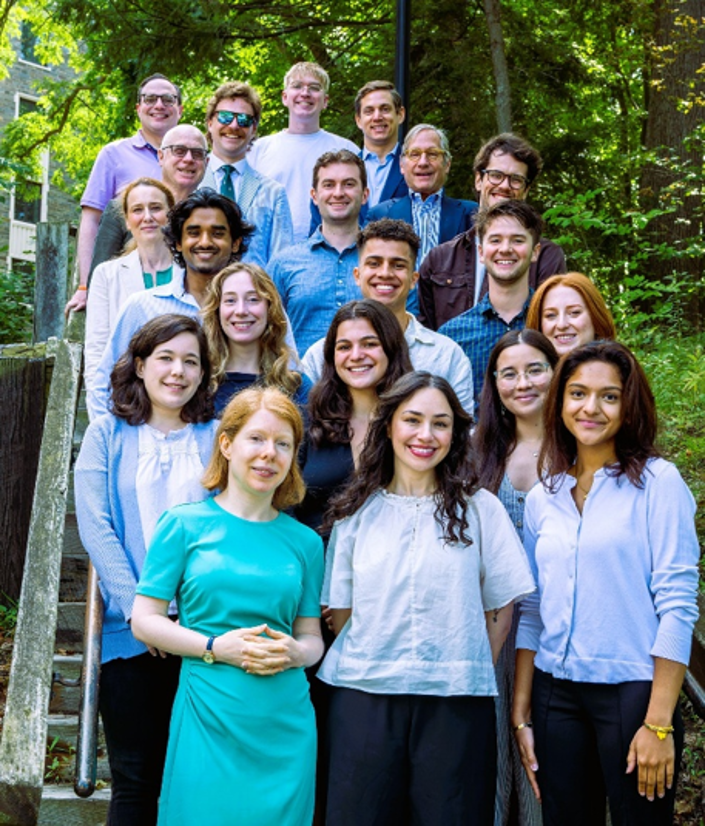
The Cornell Law School First Amendment Clinic hosted the latest version of its heralded two-day pre-semester Bootcamp on August 21 and 22. Once again the line-up of speakers and panelists was comprised of major figures from the First Amendment and media fields.
This semester’s event opened with a live screening of the latest Clinic-focused eCornell Keynote, Empowering Local News: A Coalition To Strengthen Independent Journalism which featured Heather Murray, Clinic Associate Director and Managing Attorney of its Local Journalism Project; Adam Tragone, the Clinic’s Local Journalism Attorney; Halle Stockton, Editor-in-Chief and Co-Executive Director of Pittsburgh’s Public Source; and Paula Knudsen Burke, Senior Supervising Attorney at the Reporters Committee for Freedom of the Press. The panelists described the unique collaboration between the Clinic, the Reporters Committee and Public Source intended to empower local news in Western Pennsylvania.
Bob Corn-Revere, Chief Counsel of FIRE, delivered the keynote address, offering a unique perspective on First Amendment history through the lens of the obscenity conviction of comedian Lenny Bruce and Corn-Revere’s work to secure a posthumous pardon for the comedian. Corn-Revere told students that “we never seem to run out of First Amendment problems. It really is something you can earn a living at.” He encouraged students to take full advantage of the “valuable opportunity” the Clinic affords.

Professor Nelson Tebbe, Associate Dean for Academic Affairs & Jane M.G. Foster Professor of Law, made a welcome return to the Bootcamp, providing students with a grounding in First Amendment doctrine. Michael Grygiel, Cornell Law School Adjunct Professor and partner at Foley Hoag; Kelly McNamee, partner at Foley Hoag; Bob Corn-Revere, Chief Counsel of FIRE; and Lisa Macpherson, Policy Director, Public Knowledge, engaged in a timely discussion of the unique challenges presented by President Trump to First Amendment freedoms, with a special focus on a lawsuit he brought against the Des Moines Register and pollster Ann Selzer over an Iowa poll conducted during the 2024 election.

Molly Linhorst, a Staff Attorney at the American Civil Liberties Union of New Jersey, discussed the ACLU’s ongoing and hard-fought work on behalf of Mahmoud Khalil, the legal permanent resident and former Columbia University graduate student who is fighting deportation arising out of his advocacy related to the war in Gaza.
As part of the proceedings, Alyse Horan ’23 was presented with the Jackson Distinguished Alumni Award for her ongoing work – first as a clinic student and then as an alumni – on behalf of a Texas freelance journalist reporting on deaths along the U.S. and Mexico border. The award is named after the Clinic’s founder and director, Mark H. Jackson, A.B. ’81, J.D. ’85.

Returning students shared advice on making the most of the Clinic experience. Kat Namon ‘27 told attendees that the chance to meet clients and develop litigation skills has been incredible. “Learning how to be professional and how to have those skills in a real live experience is really special,” she said.
Local journalism in Western Pennsylvania is at a pivotal moment. As legacy news institutions have closed in recent decades, citizens in several counties now reside in “news deserts.” The region’s experience has become a telling example of the local news crisis nationwide. Yet even as some newsrooms disappear, a new generation of independent journalists is fighting to fill the void and provide information their readers need.
A recent eCornell Keynote focused on the exciting coalition that has formed to support local journalists and news outlets: Cornell Law School’s First Amendment Clinic, the Reporters Committee for Freedom of the Press, and Pittsburgh’s PublicSource have joined forces to offer pro bono legal representation, trainings and convenings, and ongoing business and legal support. This model equips reporters with the tools and protection to pursue stories without fear while also laying the groundwork for similar efforts in other communities to safeguard press freedom and keep local journalism alive.
The panel included:
- Heather Murray, Associate Director, First Amendment Clinic and Managing Attorney, Local Journalism Project
- Adam Tragone, Cornell Law School First Amendment Clinic, Local Journalism Attorney
- Halle Stockton, Editor-in-Chief, Co-Executive Director of Pittsburgh’s Public Source
- Paula Knudsen Burke, Senior Supervising Attorney, The Reporters Committee for Freedom of the Press
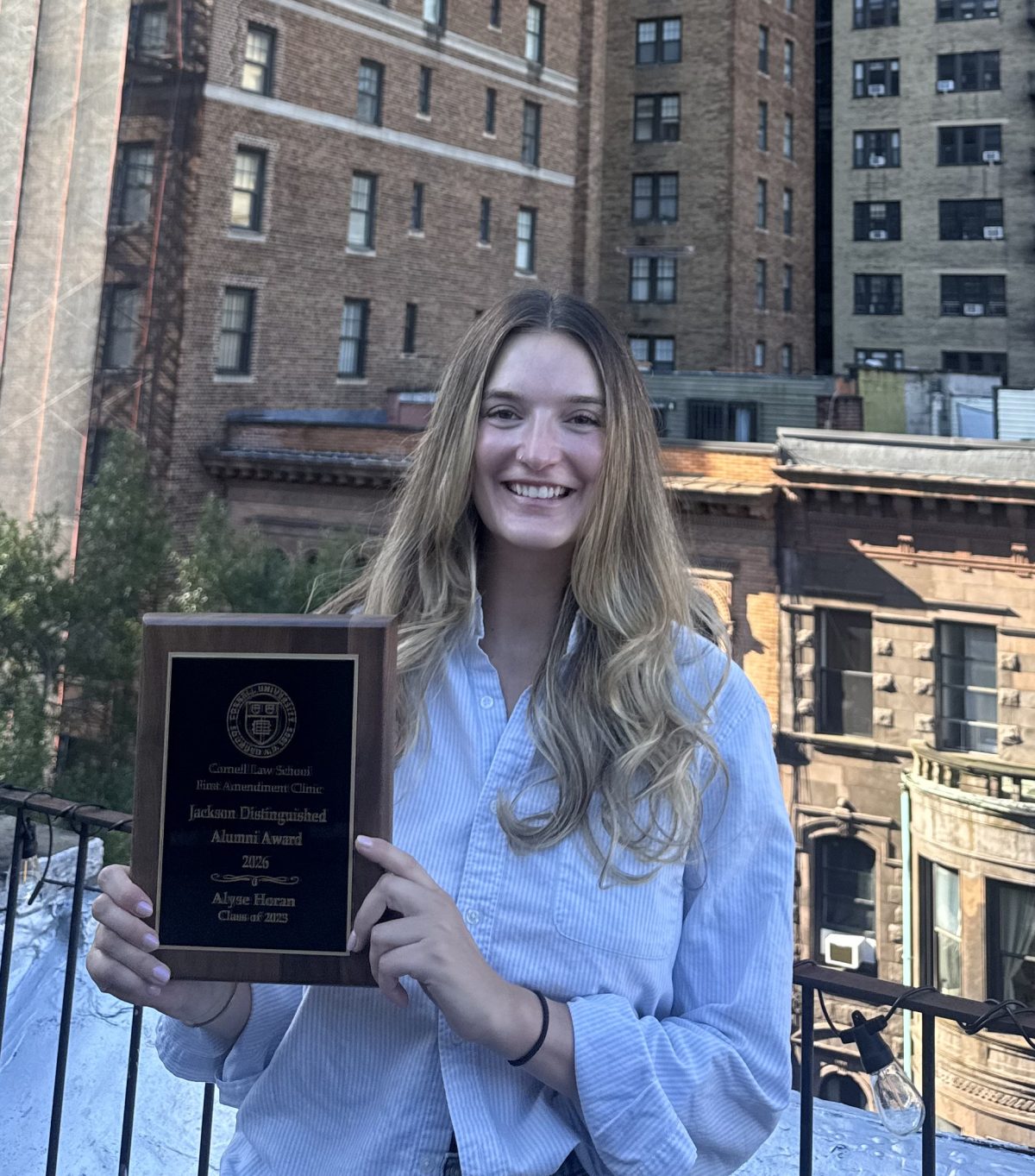
Alyse Horan ’23 received the Cornell Law School First Amendment Clinic’s Jackson Distinguished Alumni Award on August 21 for her work on a landmark border-deaths case— work that took her from Clinic student to co-counsel driving the litigation forward. The Clinic presented the award during its pre-semester Bootcamp.
The award is named after the Clinic’s founder and director, Mark H. Jackson, A.B. ’81, J.D. ’85. During Horan’s three semesters at the Clinic and after graduation, as an associate at Alston & Bird, she has worked on a case involving journalist client Michelle García, who is seeking access to records concerning autopsies of individuals who died near the U.S.–Mexico border, along with related communications. For years, García has sought to uncover accurate information behind the deaths of unidentified migrants near the South Texas border, including a more precise number of deaths and the causes behind them, by requesting access to autopsy records from Webb County and various Justices of the Peace in the region. The Clinic, with the SMU Dedman School of Law First Amendment Clinic, filed suit in June 2024, seeking access to the records from the Webb County Medical Examiner’s Office under the Texas Public Information Act and under both the United States and Texas Constitutions and the common law right of access.
Horan helped draft the complaint that brought novel First Amendment claims alongside statutory public records claims, assisted with summary judgment briefing, and took the lead in drafting an appellate reply brief filed in August.
Heather Murray, associate director of the Clinic and managing attorney of its Local Journalism Project, said that in addition to Horan’s stellar legal work, she also helped oversee Clinic students working on the matter – students in the Cornell Clinic as well as at the SMU Dedman School of Law First Amendment Clinic, which is co-counsel on the case. “Students can really see how she engages with heart and with humility,” Murray said.
Accepting the award before current Clinic students and faculty, Horan noted the Clinic has given her opportunities she would not have had as an associate at a large firm. “I’ve had drafting experience I never would have had at a big law firm as a junior associate. It’s been great stepping out from the subject matter at a big law firm and to continue to work on such a public-interest-focused matter,” Horan said.
Mark Jackson, addressing Horan at the award ceremony, said, “It’s not just that you’ve been doing this work for a long time and that you got this award; it’s that you showed the passion and the persistence that a good litigator needs to have in order to achieve a great result.”
Join the Clinic’s Adam Tragone and Pittsburgh Media Partnership for a practical training on information access in Pennsylvania ahead of the 2026 midterm elections presented by the Center for Media Innovation at Point Park University.
The free online event takes place Tuesday, September 1 from 12 – 1PM EDT. Register here.
The Clinic, on behalf of its client Advance Publications, Inc., publisher of the community newspaper The Post-Standard and its website Syracuse.com, asked a federal court to unseal critical judicial documents in a case involving the arrest of Marvin Aguilar-Garcia by U.S. Border Patrol agents for allegedly assaulting a federal agent.
The letter motion, filed in the Northern District of New York on July 29, 2026, seeks case records that would shed light on the reason the U.S. Attorney sought to dismiss the case against Aguilar-Garcia, who was alleged to have assaulted a federal agent with an automobile owner’s manual.
The motion argues that any reasons behind the United States Attorney’s request to dismiss this case against Aguilar-Garcia, set forth in a letter to the court explaining the dismissal, and the court’s decision to do so days before a jury was to be selected, are matters of legitimate public concern. The press’s ability to keep the public informed is stymied without open access to the court system.
The court requested a response from the Department of Justice by August 27.
For further background and coverage of the case, see:
Continuing the Clinic and RCFP’s multi-year effort to unseal PrimeCare Medical’s wrongful-death settlements, newly unsealed records show the prison healthcare contractor paid over $1 million to the family of a Bucks County inmate who died of opioid-withdrawal complications in custody.
Read about the case here: New court records show PrimeCare paid over $1M to Bucks inmate family
Weeks after Spotlight PA, the Centre Daily Times, and StateCollege.com—represented by the Clinic’s First Amendment Clinic and the Reporters Committee for Freedom of the Press—sued over Penn State’s trustee “gag policy,” the board lifted the speech restrictions for emeriti trustees, though the newsrooms argue the change is a tactical move to evade review and that the policy still silences the board’s active members.
Read more about the development below:
Penn State trustees updated bylaws amid free speech lawsuit • Spotlight PA
Represented by the Cornell Law School First Amendment Clinic, Investigative Post is suing the Town of Orchard Park and the Orchard Park Police Department to compel release of police arrest reports tied to ICE and Border Patrol cooperation—records the town has withheld as confidential despite their being routinely public.
Read more about the case here: Investigative Post sues Orchard Park for suppressing police reports: Investigative Post